
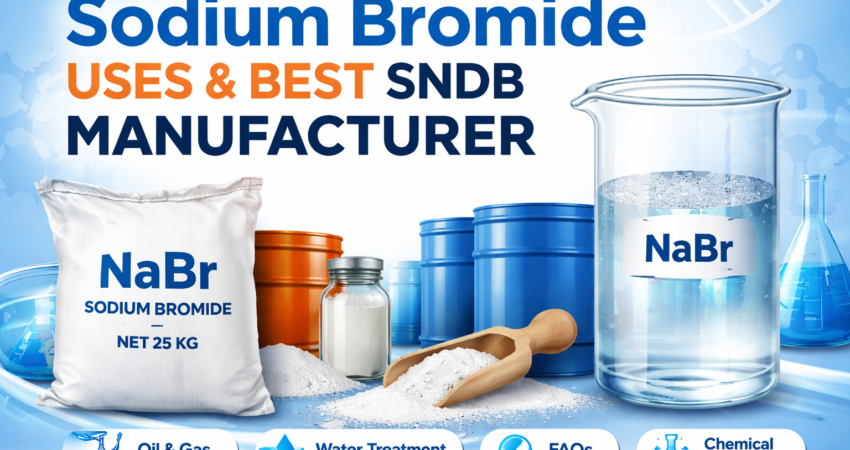
Sodium Bromide in Organic Synthesis: Mechanisms and Uses
Sodium bromide (NaBr) is a simple inorganic salt, but it plays an important supporting role in organic synthesis. It is commonly used as a source of bromide ions (Br⁻), which can participate in substitution reactions, oxidation processes, and in-situ generation of more reactive brominating agents. Because of its stability, low cost, and availability, sodium bromide is widely used in both laboratory and industrial organic chemistry.
Chemical Nature and Reactivity
Sodium bromide is an ionic compound composed of sodium (Na⁺) and bromide (Br⁻) ions. In solution, it dissociates completely, making bromide ions readily available for chemical reactions.
The bromide ion is a good nucleophile due to its relatively large size and polarizability. This makes it useful in nucleophilic substitution reactions, especially where chloride or other leaving groups are replaced by bromine.
Key Roles in Organic Synthesis
1. Nucleophilic Substitution (Halogen Exchange)
One of the most important uses of sodium bromide is in halogen exchange reactions. For example:
- Alkyl chlorides can be converted into alkyl bromides using NaBr in polar solvents.
- This typically proceeds via an SN2 mechanism.
Mechanism idea:
- Br⁻ attacks the carbon attached to a leaving group (like Cl⁻).
- The leaving group departs simultaneously.
- A new C–Br bond is formed.
This reaction is especially useful because alkyl bromides are often more reactive intermediates than chlorides.
2. In-Situ Generation of Bromine (Br₂)
Sodium bromide is often oxidized to bromine in the reaction mixture using oxidizing agents such as chlorine, hydrogen peroxide, or hypochlorous acid.
Example:
- NaBr + oxidant → Br₂ (generated in situ)
This bromine is then used for:
- Electrophilic bromination of alkenes
- Aromatic bromination (with catalysts)
This method is safer and more controllable than handling liquid bromine directly.
3. Radical Bromination Support
In radical reactions, sodium bromide can contribute bromide ions that form bromine radicals under oxidative conditions or UV light. These radicals can participate in:
- Allylic bromination
- Benzylic bromination
Although not the primary brominating reagent, NaBr is often part of the system that generates reactive bromine species.
4. Phase-Transfer Catalysis Systems
Sodium bromide is frequently used in phase-transfer catalysis (PTC), where bromide ions are transferred into an organic phase using a catalyst. This enables reactions such as:
- Alkylation reactions
- Substitution reactions in biphasic systems (water + organic solvent)
5. Industrial Organic Transformations
In industrial chemistry, NaBr is used in:
- Synthesis of pharmaceuticals (as intermediate bromination source)
- Production of agrochemicals
- Polymer modification reactions where brominated intermediates are required
Advantages of Sodium Bromide in Synthesis
- Cheap and widely available
- Easy to handle compared to elemental bromine
- Stable under normal storage conditions
- Generates reactive bromine species when needed
- Useful in both laboratory-scale and industrial-scale reactions
Limitations
- Requires oxidants or specific conditions to become highly reactive in many cases
- Less reactive than direct bromine (Br₂) in electrophilic reactions
- Not suitable for all bromination reactions without activation
Safety and Handling
While sodium bromide itself is relatively low in toxicity compared to bromine, it should still be handled with care:
- Avoid ingestion or inhalation of dust
- Use gloves and eye protection in lab settings
- Be cautious when oxidizing NaBr, as bromine vapors are toxic and corrosive
Sodium bromide is a versatile reagent in organic synthesis, primarily valued as a bromide ion source. Through substitution reactions, in-situ bromine generation, and participation in catalytic systems, it enables a wide range of transformations. Its stability, affordability, and adaptability make it an essential compound in both academic and industrial organic chemistry.
sndb best manufacturer and supplier and exporter in world.